Context
Manual deploys to Kubernetes drift over time, and nobody can say what is actually running. GitOps fixes that by making Git the single source of truth. I built this to learn the full workflow hands on.
What I Built
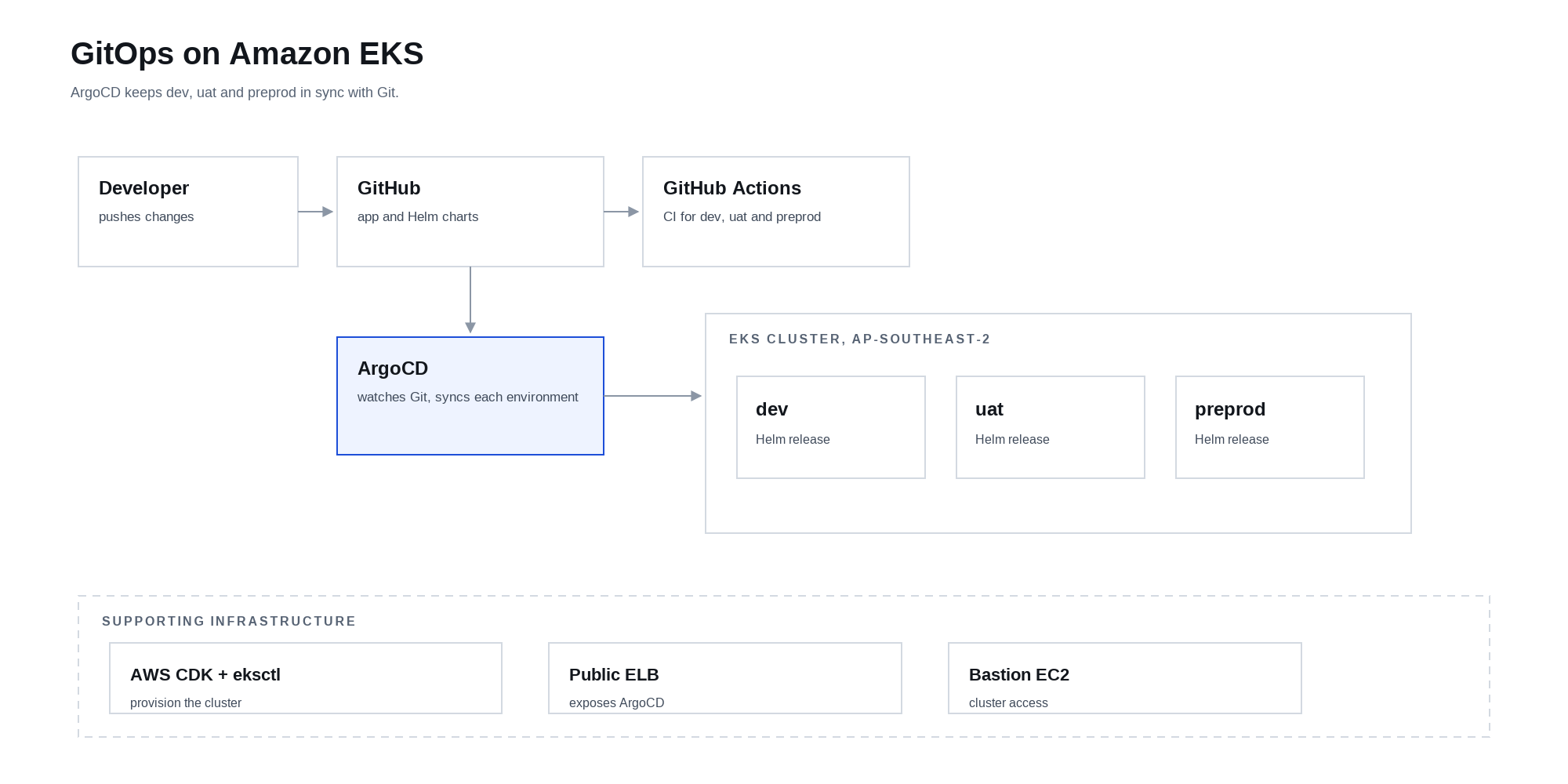
- An EKS cluster (
gitops-lab) in ap-southeast-2, provisioned with CDK and managed with eksctl and kubectl. - Helm charts for the application, with separate dev, uat, and preprod environments.
- ArgoCD watching the Git repo and syncing each environment automatically.
- GitHub Actions pipelines across the three environments.
- ArgoCD exposed through a public ELB, with a bastion EC2 host for cluster access.
Problems I Debugged
This is the valuable part of the project.
- Rotating ArgoCD’s SSH credentials for the Git repo cleanly using
--upsert. - CDK teardowns failing because orphaned ALBs and NAT gateways kept blocking VPC deletion.
- YAML indentation errors in ArgoCD Application manifests.
- A deprecated container image registry breaking pulls, plus port mismatches between service and container.
- I rebuilt the pipeline from scratch several times, which taught me the order things must be created and destroyed in.
What I Learned
The project made the GitOps loop concrete: commit a change, let ArgoCD notice it, and reconcile the cluster to match. Debugging the teardown path was just as instructive as the deploy path — cleanup order matters as much as creation order.
Note
Built during my Systems Limited internship as a guided learning project, not a production system. The repository is private.