Context
Commercial VPNs mean trusting a third party with your traffic. I wanted a private VPN I fully control, built the way a production team would build it: repeatable, secure by default, and documented.
What I Built
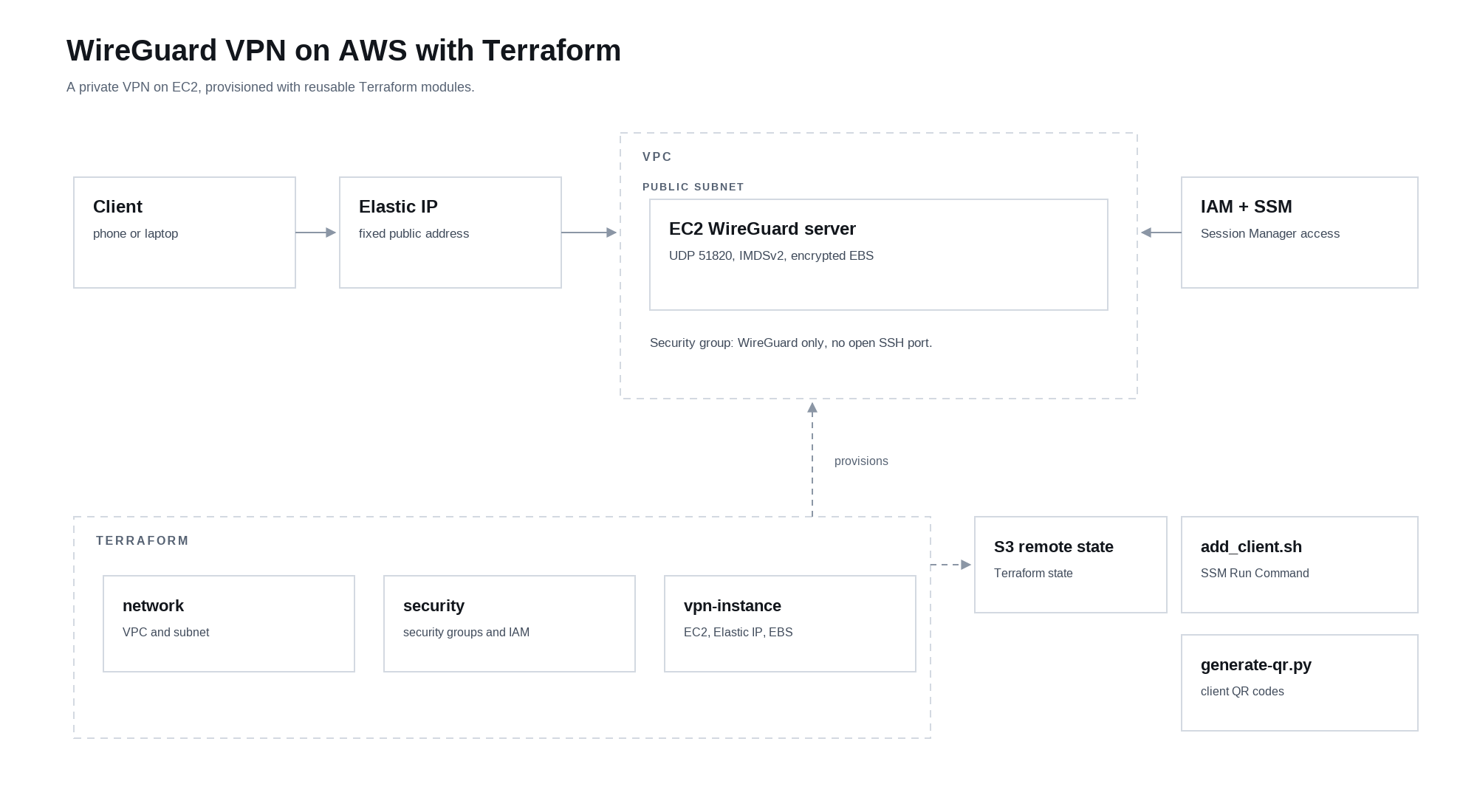
A WireGuard VPN server on an EC2 instance, provisioned entirely with Terraform. No console clicking.
- The Terraform code is split into three modules — network, security, and vpn-instance — so each part can be changed or reused on its own.
- Terraform state is stored remotely in S3 instead of on my laptop.
- An Elastic IP gives the server a fixed address, so client configs never break after a restart.
Security Decisions
- No SSH port is open. I access the server through AWS SSM Session Manager, controlled by IAM.
- IMDSv2 is enforced on the instance, which blocks a common class of credential theft attacks.
- The EBS volume is encrypted.
Automation
add_client.shcreates new VPN clients remotely using SSM Run Command, so I never log into the box.generate-qr.pyturns a client config into a QR code, so a phone can be set up by scanning.
Outcome
Working end to end, with a public tutorial site on GitHub Pages so anyone can follow along and rebuild it.